With regard to industrial cutting, choosing the right blades is an engineering issue rather than simply selecting the sharpest and hardest cutting edge. This particular blade should be compatible with the material used, the mechanics involved, and the speed at which the cut will be produced. An incorrect selection will cause damage to the blade and produce a poor cut and vibrations, all avoidable. This is why selecting Custom Industrial Blades with Inducto Tech requires proper application knowledge and expectations of its performance.
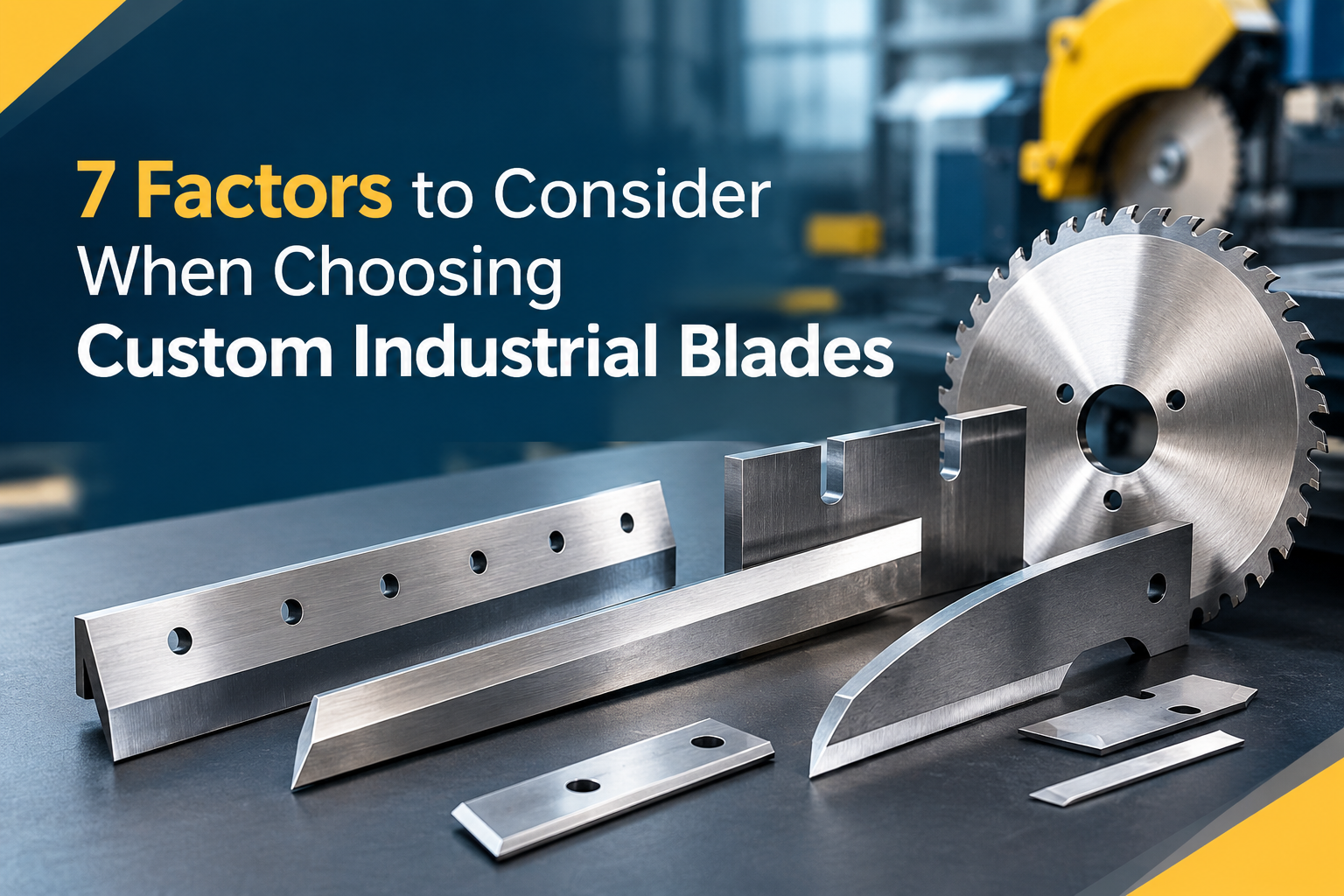
7 Factors to Consider When Choosing Custom Industrial Blades
1. Understand the Material Behavior:
The physical characteristics have a direct bearing on the design of the blades and their effectiveness. Before choosing a blade, you need to take into account:
- Hardness and thickness: The amount of cutting force that is needed and the necessary strength of the blade’s edge.
- Tensile strength: The stronger the material is, the stronger its blade should be.
- Abrasiveness: The abrasive nature of the material might cause faster wear of the edge.
- Flexibility: Flexible materials might require a special design of the edge in order to avoid tearing.
Surface characteristics: Surface coatings, texture, and other factors that affect the process of cutting.
2. Select the Right Blade Material:
Blade life depends significantly on selecting the appropriate material. Common factors considered include tool steel, carbides, and speciality materials, each with different performance properties.
Blade material choice should consider:
- Hardness: This offers wear resistance and protection from blade edge distortion.
- Toughness: Enables the blade to withstand impacts and operating stress.
- Abrasion resistance: Becomes important when dealing with abrasive materials.
- Edge holding ability: Blade performance depends on its edge-holding ability.
- Operating environment: Temperature, load, and other manufacturing conditions may influence material selection.
Not always maximum hardness is required. Hardness versus toughness balance is key to avoid early chipping/breakage.
3. Specify Geometry for the Cutting Process:
Blade geometry directly affects cutting force, penetration, material deformation, and edge stability. Key parameters include:
- Bevel angle: Influences cutting force and edge strength.
- Edge profile: Determines how the blade engages with the material.
- Blade thickness and diameter: Must suit the cutting application and machine.
- Teeth or serration design: Important for specific cutting and slitting processes.
- Clearance and cutting configuration: Can influence material deformation and cut consistency.
Custom geometry becomes particularly useful when standard blades cannot deliver the required cutting behaviour, accuracy, or process stability.
4. Match the Blade to Machine Dynamics:
Blade performance is closely connected to the machine in which it operates. Before finalising a blade specification, evaluate:
- Mounting: It is necessary to have proper mounting of the blades for stability.
- Run-out: If there is too much run-out, it may lead to uneven cutting and wear of the blades.
- Clamp: The clamp helps in keeping the blade in place.
- Rigidity of machine: Any movement in the machine will affect the cutting.
- Tolerances: Dimensions such as bore, thickness, diameter, and others should be in accordance with the equipment.
5. Define the Required Cut Quality:
Different industrial processes have different expectations for cut quality. Clearly define the required output before selecting the blade.
Important requirements may include:
- Dimensional accuracy: Required where precise cut sizes are critical.
- Clean edges: Helps minimise burrs, tearing, and unwanted deformation.
- Controlled slitting: Important for continuous production applications.
- Surface finish: The cutting process should meet the required material finish.
- Production consistency: The blade should maintain acceptable results over repeated cycles.
- Material wastage: Proper blade selection can help control unnecessary scrap.
Defining measurable cut-quality requirements allows the blade specification to be developed around actual production needs rather than generic performance claims.
6. Evaluate Wear, Service Life and Total Cost:
The cost of purchasing the blade is not the whole cost of operation. It can be an expensive blade when frequent replacement is needed.
It should be judged by:
Edge hold: Performance of the cutting edge.
- Frequency of replacement: Frequent replacement can lead to more labor costs.
- Reshaping ability: It depends on the suitable blades that can give service for more time.
- Material waste: In case of poor cutting performance, it leads to the wastage of material.
- Downtime due to blade replacement: Replacement of the blade leads to production inefficiency.
At Inducto Tech, several aspects like expected service life, application, and productivity considerations play a role in the development of blades.
7. Choose a Manufacturer with Engineering Capability:
Custom blade manufacturing requires more than producing a blade according to size. A technically capable manufacturer should be able to convert the application requirements into the right specification.
Look for expertise in:
- Material selection: Choosing a grade suitable for the cutting application.
- Blade geometry: Developing the correct edge and dimensional configuration.
- Dimensional tolerances: Maintaining accuracy for reliable machine fit.
- Heat treatment: Achieving the required hardness and toughness.
- Finishing processes: Ensuring the required edge and surface quality.
- Application understanding: Considering the actual machine and production conditions.
An engineering-focused manufacturer can evaluate drawings, samples, material specifications, and operating parameters to develop blades that perform reliably under actual production conditions.
Best Custom Industrial Blades – Inducto Tech:
The best Custom Industrial Blades are designed for the entire cutting process rather than as individual elements that make up the whole.
When materials, blade materials, geometry, machine conditions, cut quality, and economics are all integrated, industrial blades will be able to provide better cutting consistency, longer service intervals, less material loss, and increased reliability in the process. The precision-engineered industrial blades offered by Inducto Tech have been designed to satisfy rigorous application and production demands.
Frequently Asked Questions:
1. What are Custom Industrial Blades?
Custom Industrial Blades refer to blades that are designed based on the material, machinery, size, shape, and the cutting process.
2. What are the criteria for choosing industrial blade materials?
Criteria include the material to be cut, working environment, desired hardness, toughness, wear resistance, and longevity.
3. Why is the shape of the blade important?
The blade shape influences the cutting forces, edge stability, material deformation, and general cut quality.
4. How can the life of industrial blades be extended?
Choose the right blade material and shape, maintain proper machine alignment, and practice the right operation and maintenance procedures.